
Five Minutes (Part 3)
The petition took eighteen evenings and collected eight hundred and forty-one names, which was more people than actually lived on Elm Lane. Zara carried it into the council building in a supermarket bag, because she had nothing else big enough.
The conference room was hot and half empty. The garden came up as item nine, after a discussion about parking meters that lasted fifty minutes.
Zara had practiced. She talked about the eleven years, the fourteen volunteers, the school class, the four hundred kilos of vegetables that had gone out of that gate the previous summer to people who didn't grow them. She put the sunflower measurements on the table. She kept to her five minutes.
Then a man from the property department explained, politely, that the sale had been agreed in principle, that the developer had already carried out surveys, and that the council had a duty to get the best value it could for its land.
“Agreed with who?” Zara said.
“With the developer. In principle.”
“We're the people who use it. Nobody agreed anything with us.”
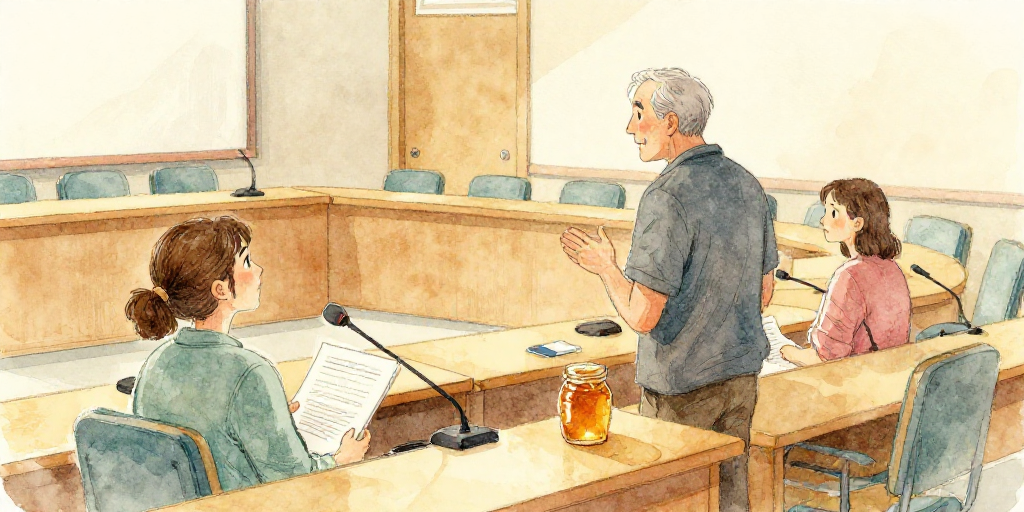
The chair said her time was finished. Declan stood up.
He had no notes. He had a jar of honey from the hives at the far end of the site, and he put it on the table in front of him and left it there. He said that he had lived on Elm Lane for thirty-one years. He said that his wife had died in March, four years ago, and that for eight months after that the only reason he left the house on a Tuesday was that somebody had to water the greenhouse.
“You can build houses on it,” he said. “I'm not going to claim you can't. I'm saying you'd be selling the one place on that street where people who don't know each other say hello. I don't think that's surplus.”
Nobody spoke for a moment. Then a councilor at the end of the row asked the property man a question: how much of the site, exactly, did the developer actually need?