
The Model of Elm Street (Part 3)
Thirteen days. That was the new number, and it sat on the bench between them like a third person. The moved date had one simple impact: every evening was a work evening now.
The woman two doors down had built her own back porch, alone, in a single summer. She had a garage full of tools and a way of looking at people that made them explain themselves quickly. Ethan knocked on her door on Monday and did exactly that.
“A model,” she said, when he’d finished. “Like a toy.”
“Like a drawing, but in three dimensions,” Simone said.
“That’s a toy with extra words.”
Simone held out her phone: a photo of the real street, and next to it a photo of the model. The woman took the phone, made the picture bigger, and looked at it for a long time. She stopped talking about toys.
“Whose house is that one?” she asked, pointing at the yellow one on the corner.
“Yours,” Ethan said.
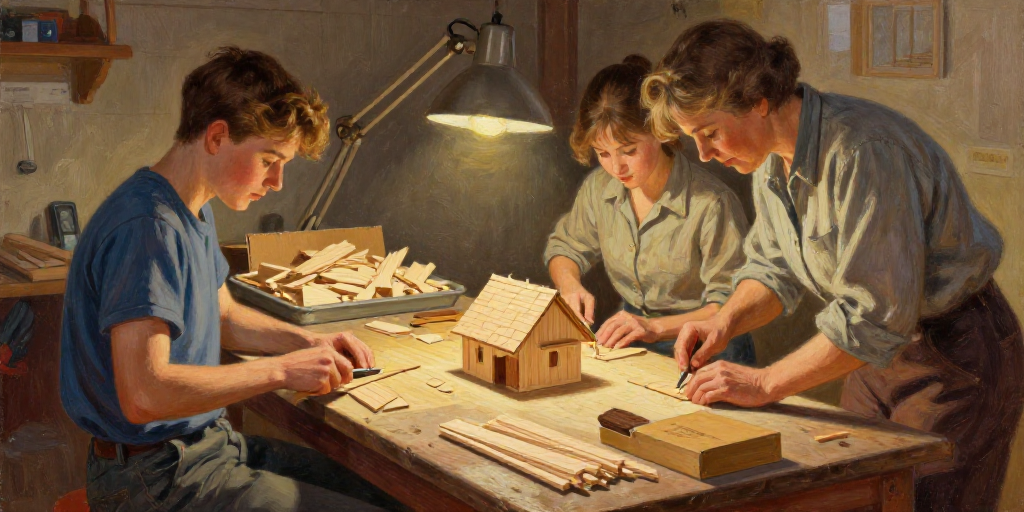
She came over that afternoon with a box of cedar — thin, pale pieces of wood, each about as long as a finger. She showed them how to hold the knife and how to follow the grain of the wood, and she made them cut fifty each before she would let them keep any.
Shingles are the small flat pieces that cover a roof, and a roof at one to forty-eight needs a great many of them. In nine evenings the three of them cut about four hundred, and no two were the same. Some were a little wide. One had a knot in it, dark as a coffee stain, and the woman set that one at the front, right above Ethan’s dented mailbox, on purpose.
Simone hated it for two days. It didn’t match. Her walls were exact and her windows were even, and now there was this rough brown thing sitting on top of them.
Then on the Thursday she turned the lamp on and looked at the model from the far end of the garage, and the contrast was the whole point. The wooden roof made her clean walls look sharper. Her clean walls made the roof look hand-cut, which it was.
On Saturday morning they wrapped the model in a blanket and carried it in through the side door of the Civic Center. Through the doorway they could see the other tables: a bridge lit from inside, a factory printed in white plastic, a downtown block with a streetcar that actually ran.
“Okay,” Simone said. “Don’t look at the other tables.”
Ethan was already looking.