
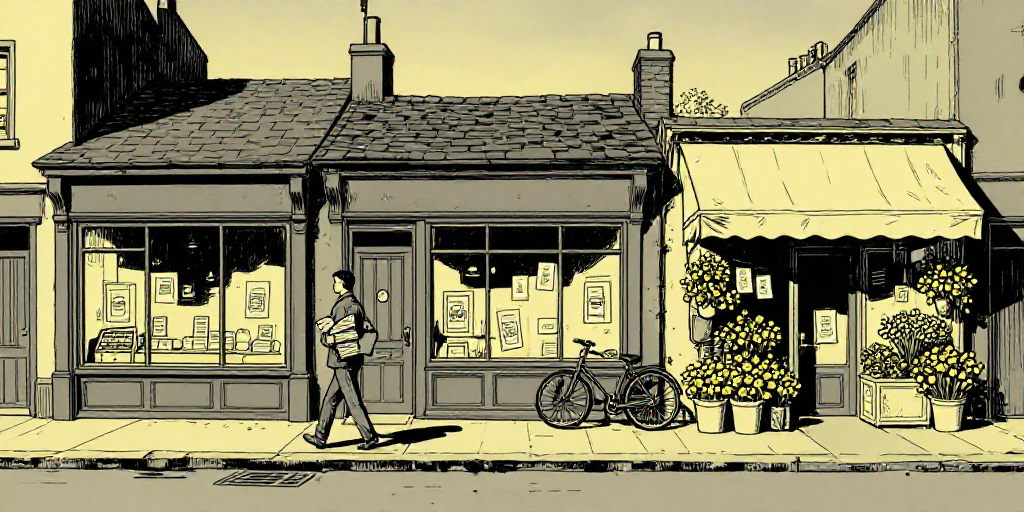
The Bookshop Vote (Part 2)
By Wednesday they had four hundred postcards, printed cheap, with a drawing of the shop’s front window on one side and the voting address on the other.
Otto took two hundred of them up and down Hope Street. The bakery took a stack for the counter. The barber put one in the corner of his mirror. The flower stall at the Saturday market took thirty and gave him a bunch of something yellow for Joan. By Thursday the postcard was in eleven windows, and a woman Otto had never met stopped him outside the pharmacy to tell him she’d already voted twice, once on her husband’s phone.
“You can’t do that,” Otto said, delighted.
Then the press turned up. The local paper sent a reporter on Thursday afternoon, and she stayed an hour and a half. She asked Joan how a shop with one room competes with a chain that has a parking lot, a café, and that level of influence online.
“We don’t sell more books than Kestrel,” Joan said. “We sell the right book. Ask him.” She pointed at Otto with her pencil. “He came in here at fourteen, wanting something about spiders.”
“She gave me a novel,” Otto said. “About a boy with a spider. I read it in a day. I’ve been here ever since.”
The photographer put Joan in the window with the light behind her. The story ran on Friday, page five, with the word “vote” in the headline, and by Friday evening the shop had gone from nineteen votes to nine hundred and forty.
Kestrel had five thousand. But Kestrel had stopped moving, and Hopewell hadn’t.
On Friday night Otto stood in the doorway counting the chairs they’d borrowed: thirty-eight now, from the church hall and from three kitchens on the street. Joan was writing names on paper cups.
“We might actually do this,” he said.
She didn’t answer. She was looking past him at the sky over the roofs, which had turned a flat, strange yellow-gray, and then down at the drain by the door, which blocked every autumn and had not been cleared since spring.