
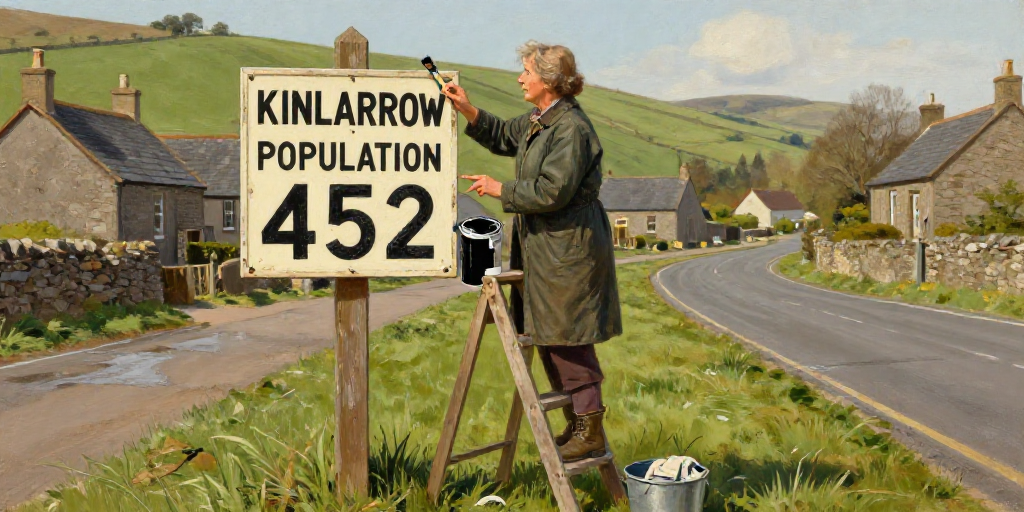
Kinlarrow, Population 380
For thirty springs Doreen had carried the same ladder out to the same post at the edge of the village and repainted the same three figures: KINLARROW. POPULATION 380.
She had never once asked where the number came from. It had been there when she moved into the cottage, black on cream, and repainting it was simply one of the things that happened in April, like the church gutters and the sheep. Kinlarrow sits four miles inside the regional border, which is why its post comes from one town and its school money from another.
The letter arrived in February. It said that the primary school would close in the summer, it set out the reasons in a numbered list, and halfway down the list Doreen met an old friend: 380.
She spent three weeks proving it wrong. She had the electoral roll from the library open on her lap and a notebook on the arm of the chair, and when the roll ran out she walked. She counted the eight new houses above the burn, which had been fields the last time the sign was true. She counted the six flats in the old mill. She counted the family at the caravan site who had been there four years and whom nobody in the capital city had ever heard of. Four hundred and fifty-two.
A man from the regional office phoned her the following Tuesday. He was kind about it, which was worse. He told her that the population figure formed no part of the decision at all; that schools were funded on pupil numbers, and that Kinlarrow had eleven pupils. He said he was sorry. He asked her, gently, not to repaint anything on his account.
So she had been right, and being right had changed nothing.
What changed something was the hill. In March the road over the pass went — a whole shoulder of it slid into the trees after a wet fortnight — and the short route to the town school went with it. The office had a rule of its own about that: no primary child on a bus for more than forty-five minutes. Round by the coast road, on a dry day, with no tractor in front, the journey took fifty-one. A second letter came in April. The school would stay open, it said, for review.
Doreen carried the ladder out anyway. She painted over the 3 and the 8 and the 0 in cream, waited for it to dry, and put up four hundred and fifty-two in black.
It is a true sign now, which is not the same as a useful one. Four hundred and fifty-two people, eleven of them small enough to need a school that had been saved by a hillside and not by a number — and one of them, Doreen thought, coming down the ladder, ought to be taught to paint.