
Room Four
Take the stairs to the second floor and stop in the doorway. You’re standing in the Cloth Hall in Ypres, in Belgium. The stone above your head looks hundreds of years old, but most of it was put there after 1930. In 1918 there was almost nothing here: broken walls and one piece of the tower. The town was rebuilt after the war, from old photographs.
Room four. Turn left.
The first case on your right holds a rifle. It’s British, made in 1915, and there is nothing to look at: a piece of wood, a piece of metal. It’s here because of how many there were. Almost every soldier on this ground carried one, and most of them never used it the way you’re imagining. The fighting on this front was not mainly men against men. It was guns against ground.
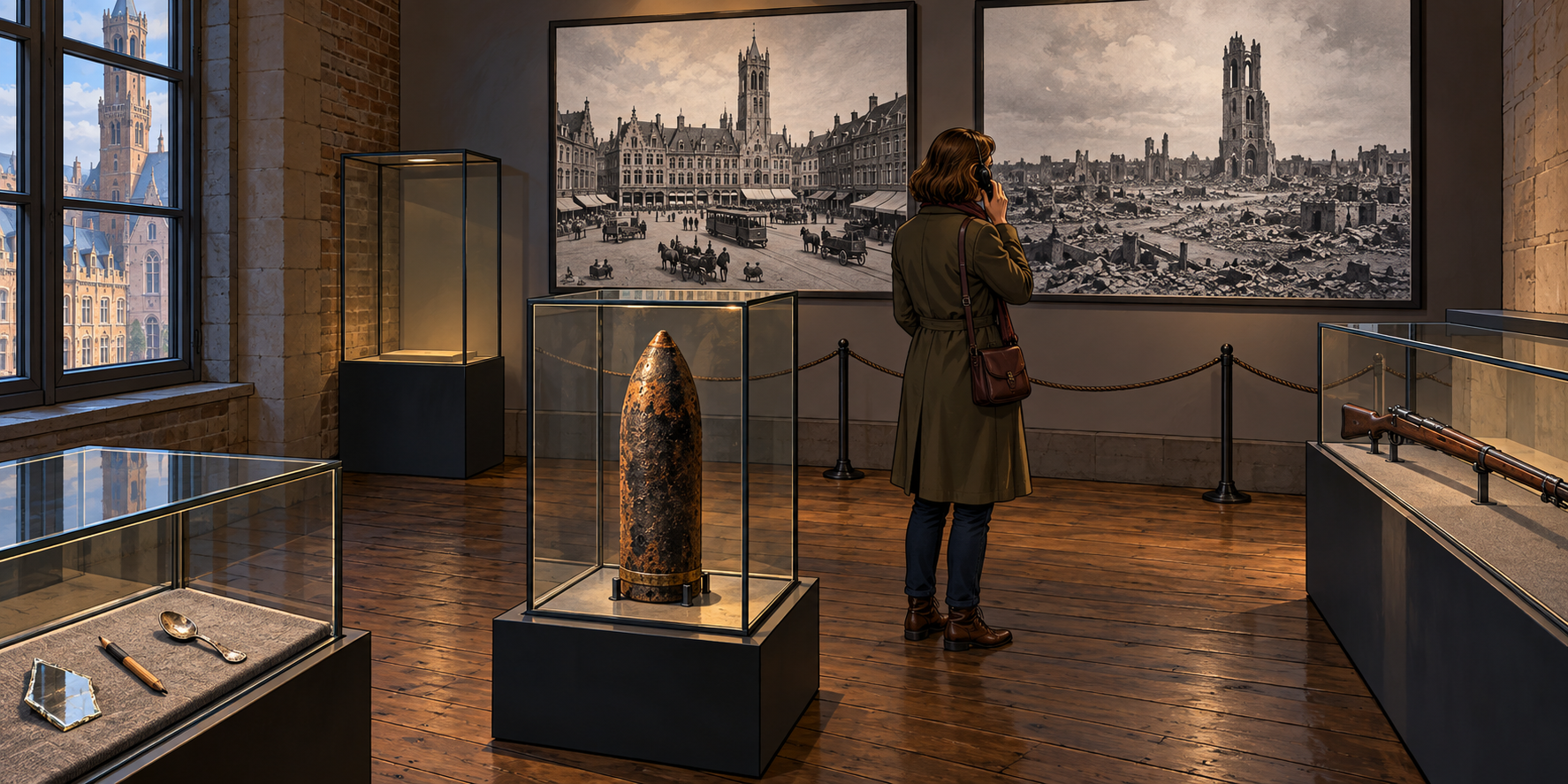
The second case, in the middle of the room, is the one people photograph. It’s a shell, a bomb of that war, fired from twenty kilometers away by a crew who never saw where it landed. Millions of them fell on these fields. Farmers here still find them in the ground, and a truck still comes out every week to collect what they find, more than a hundred years later.
Now the small case by the window. A postcard, a pencil, a piece of a mirror, and a spoon with a name scratched into the handle. They came out of a field east of here, together, in the 1990s. Someone’s first name, and nothing else.
Take three steps to the wall of photographs. On the left, the market square in 1913, with a tram and a hat shop. On the right, the same square in 1918. Apart from one broken piece of the tower, nothing in the right-hand photograph is taller than a man.
The last case is empty, and that is on purpose. There is no number on the wall for the deaths here, because no honest number exists. Over four years, between this town and the next one, the count runs into the hundreds of thousands, and every way of counting gives a different answer. What we can say is this. The killing was done by machines, from far away. The dying was not. It happened one human being at a time, in extreme cold, in extreme noise, usually within sight of a farm.
Some of the villages out there were never rebuilt. They exist now as names on a map, and nothing more.
When you leave, walk down to the Menin Gate at the end of the street. More than fifty thousand names are cut into the stone: men whose bodies were never found. At eight o’clock tonight the traffic will stop, as it has almost every night since 1928, and someone from the local fire station will play the Last Post. It takes about a minute. Then the cars move again, and the town, which does exist, goes back to its evening.