
Eight Minutes
The number on the wall by the outer door said minus forty-one. Ingrid had read that number every day for six weeks, and she still stopped to look at it.
Her experiment was simple enough to explain to her mother on the phone. Take a container of salt water. Put it outdoors. Measure how long it takes to go from liquid to solid. Do it again with fresh water, and again with the salt water at a different strength. Six weeks of that and you have real research — or at least numbers that the physics people in Tromsø can argue about.
Her prediction for that afternoon was forty minutes. She had written it in the notebook before she went out, because a prediction you write afterwards is not a prediction.
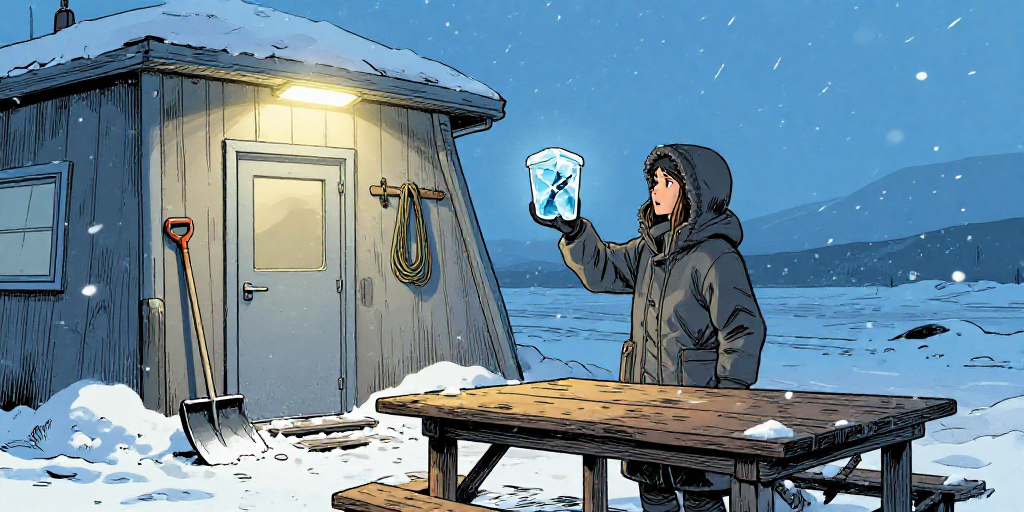
She carried the container out at ten past two, set it on the wooden table behind the station, and started the timer. The wind was stronger than the day before. She noticed that, and she did not think about it enough.
At eight minutes she went back out to check. The salt water was solid. Not nearly solid: solid all the way through, with a white crack running across the top where the ice had pushed outward. She picked the container up and turned it over. Nothing moved inside.
Eight minutes. Her prediction had been forty.
She stood there with one hand on the table, working it out, and the cold worked faster than she did. The salt strength did not matter here. The wind did. Moving air takes heat away from anything warmer than itself: a container of salt water, a wooden table, a human being in a hood with a strip of skin showing above the scarf.
Ingrid had planned to be outside for two minutes. She had been outside for five. Her fingers had stopped being cold, which is the part they warn you about at the start, in the safety talk that everybody half listens to. She pulled the hood tighter with a hand that did not want to close.
She left the container on the table and went in.
Indoors, at the long table, she wrote the real number down: eight minutes. Then she wrote the wind speed next to it, and under that, one line for the next person who opened the notebook.
The manual gives you thirty minutes outside at this temperature. The manual assumes there is no wind. Check the wind first.
She looked at the door, and at the number beside it, and then she went to find somebody to tell.