
The Model of Elm Street (Part 1)
The rules of the Muncie model competition were three lines long. Build a model of a real place in the city. Make it no bigger than a card table. Bring it to the Civic Center on the first Saturday in April.
Ethan and Simone chose their own street.
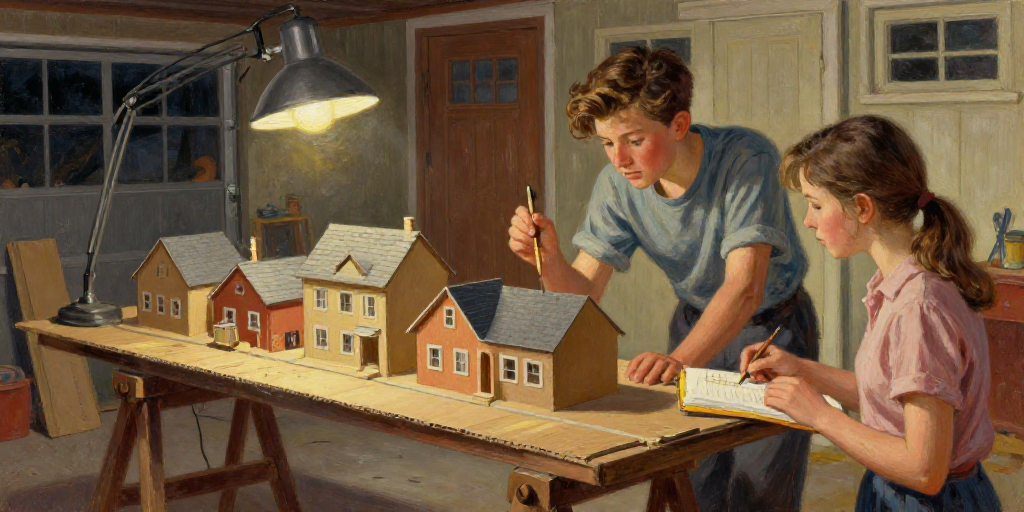
They worked in Ethan’s garage, on an old door laid across two sawhorses, and by the second week they had a system. Simone built the houses. She measured the real ones with a tape, wrote every number in a notebook, and cut the walls out of thick card at one to forty-eight — one inch on the model for every four feet of Elm Street. Her corners were square. Her windows were even. From three feet away, the row of little houses looked like a photograph of the street.
Ethan did everything else. The mailbox outside number 12, with the dent in the side where a truck had backed into it. The bent basketball hoop above a garage door. The crack in the sidewalk where a tree root had pushed the concrete up into a small gray hill.
“Nobody’s going to see that crack,” Simone said one evening. He was painting it with a brush the size of an eyelash.
“I see it.”
“The judges look at a model from three feet away. They see the shape and the color. That level of detail is extreme, and it costs us hours.”
“It costs me hours,” Ethan said. “You’re building walls.”
They had that argument about once a week, in a friendly enough way. Simone’s focus was the whole street: the line of the roofs, the way the model would look from the door of the hall. Ethan’s focus was the small stuff, and he could spend three hours on something the size of a grain of rice.
In the third week of March they finished the roof section for the east side — four houses joined together, covered in narrow gray paper shingles, hundreds of them, cut and laid in rows. It was the best thing either of them had made. They stood it on the bench to dry.
The garage smelled of glue. Ethan opened the window.
He left it open.